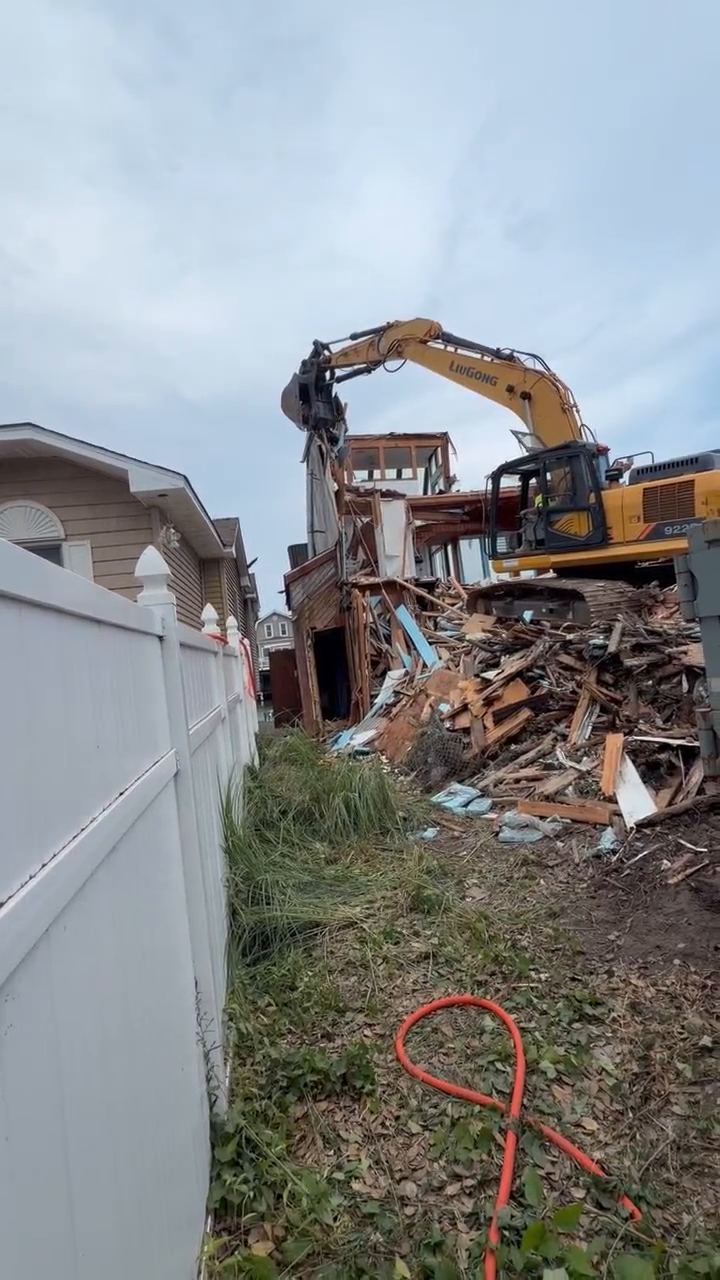
- A two story home came down in Atlantic City with a neighbor's garage on one side and a vinyl privacy fence running the length of the other.
- Nothing about the teardown was fast. Material got pulled in and worked down in sections so the fence line and the house next door finished the job untouched.
- Tight site teardowns across South Jersey. Call (609) 290-3565 for a free estimate.
The Fence Line Is The Job
On paper this was a two story residential teardown. In practice it was a job defined by two things that were not coming down: a neighbor's stucco house with an attached garage a few feet off one side, and a vinyl privacy fence running the full length of the other.
Everything gets planned around what stays. Machine position, swing radius, which direction the frame gets pulled, where the pile builds. On a site like this the constraint is not the house, it is the clearance.
Pull It In, Don't Push It Out
The frame came apart in sections, pulled inward toward the center of the lot. Older two story homes give up their material in a particular order once the roof structure is broken: rafters, then the upper walls, then the floor system, then whatever is holding the first floor together.
Working it that way keeps the debris compact and predictable. It also keeps the operator's sightline on the thing that matters, which is the gap between the machine and the property line.
Sorting As You Go
Older houses come apart into a mixed pile: framing lumber, plaster, siding, roofing, and whatever previous owners added over the decades. On this lot there was old chain link fencing buried in the debris, which is exactly the kind of thing that has to be pulled out rather than loaded into a truck with everything else.
Separating as the work runs is faster than sorting a finished pile. Wood goes one way, metal another, masonry another. By the time hauling starts the loads are already organized, and that shows up in disposal cost rather than in the crew's schedule.